
How to Prepare for Home Medical Equipment Delivery
On this page
- Quick answer
- Confirm the order and supplier
- Prepare the route and placement space
- Check power, water, and emergency needs
- Inspect the equipment at delivery
- Require hands-on training
- Organize support and records
- Delivery-day checklist
- Limitations and urgent concerns
- Frequently asked questions
- Medicare and supplier notes
- Measure the entire delivery path
Quick answer
Before home medical equipment arrives, confirm the prescriber's order, exact equipment, supplier, purchase or rental status, coverage, expected charges, accessories, delivery window, setup, and training. Measure the full path from vehicle to final location, clear stable space, identify required power or water, and arrange for the user and caregiver to attend. Do not accept unexplained substitutions or sign that training and setup are complete before they actually are.
Equipment needs differ. Follow the prescriber, supplier, manufacturer, health plan, and emergency instructions for the specific device.

Miracle Home Health Care, Inc
Los AngelesLos Angeles CountyCalifornia
5670 Wilshire Blvd # 1600, Los Angeles, CA 90036, USA
Confirm the order and supplier
Ask for the equipment name, model or functional specification, prescribed features, quantity, accessories, consumables, and whether the item is new, rented, purchased, or repaired. Confirm who owns it, who handles maintenance, and what happens when it is no longer needed.
For Medicare, verify that the prescriber and supplier meet enrollment requirements and ask whether the supplier accepts assignment. Coverage and cost depend on the item and plan. Contact the health plan or Medicare directly using official contact information when a billing statement is unclear.

FirstLight Home Care of Orange
1740 W Katella Ave # M, Orange, CA 92867, USA
Prepare the route and placement space
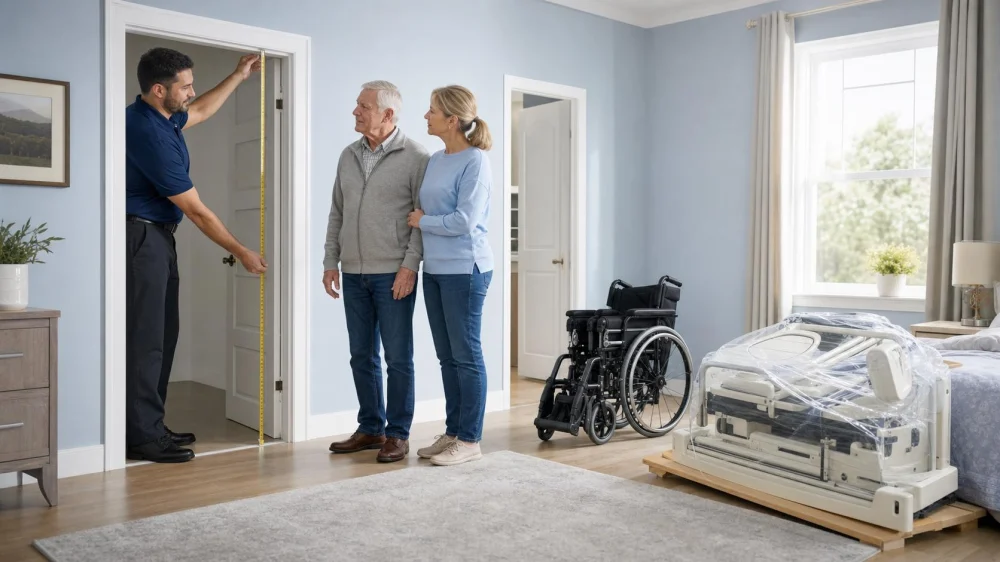
Measure doors, halls, elevators, stairs, turns, thresholds, and the final footprint. Include room for the user, caregiver, transfer, controls, cables, maintenance, and emergency access—not just the equipment's outside dimensions. Tell the supplier about stairs or a difficult parking entrance before delivery.
Remove loose rugs, clutter, and fragile objects from the approved path without taking away supports the person uses safely. Protect pets and arrange building access. Do not dismantle rails, doors, or structural elements without appropriate authorization and skilled help.
Check power, water, and emergency needs
Ask the supplier to assess whether the home has suitable electricity, grounding, outlet access, water, ventilation, temperature, or network connection for the equipment. Do not use improvised extension cords, adapters, power strips, or backup batteries unless the manufacturer and supplier allow them.
For life-supporting or power-dependent equipment, obtain a device-specific outage and emergency plan before use. Record backup duration, alarms, emergency contacts, replacement supplies, evacuation limits, and when to call emergency services. Never improvise oxygen placement or storage; follow the supplier's fire-safety instructions exactly.
Inspect the equipment at delivery
Compare the delivered item and accessories with the order. Check packaging, model, serial number, cleanliness, visible damage, fit, stability, brakes, cords, batteries, alarms, and included supplies as applicable. Ask whether rented equipment was cleaned and serviced under the supplier's process.
Photograph condition and placement for your private record. Note missing or damaged components before signing. Do not test a device on the person until the authorized professional has set it up and confirmed the prescribed configuration.
Require hands-on training
The user and caregiver should be shown setup, normal use, transfers or positioning within their role, cleaning, storage, charging, routine checks, alarms, troubleshooting, supply replacement, and emergency steps. Demonstrate the tasks back while the trainer watches.
Ask what must be handled only by a clinician or technician. Receive accessible written or video instructions in the user's preferred language or communication format when available. Do not sign a training acknowledgment that overstates what the household can safely do.
Organize support and records
Save the order, delivery ticket, serial number, manuals, rental terms, warranty, coverage notices, invoices, maintenance schedule, supplier contacts, and emergency information together. Attach only essential contact guidance near the equipment; protect private health and account information.
Know the process for routine supplies, repair, loaner equipment, replacement, travel, moves, hospitalization, and return. Notify the supplier when contact, insurance, prescriber, location, or care needs change.
Delivery-day checklist
- Verify order, coverage, supplier, and costs.
- Measure the route and final operating clearance.
- Confirm utilities and emergency backup.
- Match model, accessories, and serial number.
- Inspect condition before signing.
- Complete setup and teach-back training.
- Record maintenance, supplies, repair, and return steps.
- Keep contacts and documents accessible.
Limitations and urgent concerns
- This guide cannot select, prescribe, fit, or configure medical equipment.
- Do not modify equipment or use unapproved accessories.
- Stop using damaged or malfunctioning equipment and follow the supplier's urgent process.
- For breathing difficulty, loss of essential therapy, injury, or another immediate threat, call emergency services.
- Coverage, supplier, rental, and replacement rules vary by plan and item.
Frequently asked questions
Can the supplier leave equipment without training?
Ask for the required setup and instruction before use and escalate to the supplier or plan if safe training is not provided.
What if the model is different from expected?
Ask the supplier to confirm that it fulfills the prescription and coverage before accepting the substitution.
Who repairs rented equipment?
Check the rental and coverage terms. Medicare guidance states that the supplier is responsible for repairs and replacement parts for certain rented DME.
Should manuals stay beside the device?
Keep essential instructions accessible while protecting personal billing and medical documents.
What if the equipment does not fit the home?
Do not force installation or unsafe use. Contact the supplier and prescriber to reassess placement or options.
Medicare and supplier notes
Medicare explains DME coverage, supplier participation, assignment, and rental or purchase differences. CMS supplier quality standards call for assessing home safety and utilities and providing instruction on setup, use, troubleshooting, cleaning, maintenance, and emergency support.
Measure the entire delivery path
Before confirming the delivery window, measure the narrowest doorway, tightest turn, stairs, elevator, and final operating space. Send those dimensions and access details to the supplier and ask it to confirm the planned delivery method.






 At Home Nursing Care - Los Angeles5.0 (3 reviews)
 Complete Home Health INC0.0 (0 reviews)
 BrightStar Care4.0 (23 reviews)
 TheKey - Formerly 123 Home Care1.0 (1 reviews)
 TheKey - Senior Home Care5.0 (15 reviews)
 Taylored Care Services LLC5.0 (2 reviews)
 Tips for Supporting Seniors With Chronic Health Conditions
 Effective Strategies for Creating Engaging Indoor Activities on Rainy Days
 How to Introduce Creative Writing and Journaling Into Daily Life
 How Gardening Improves Physical and Mental Wellness in Older Adults
 How to Transition from Hospital to Home Care: A Complete Guide
 Tips for Promoting Mental Stimulation Through Games and Puzzles