
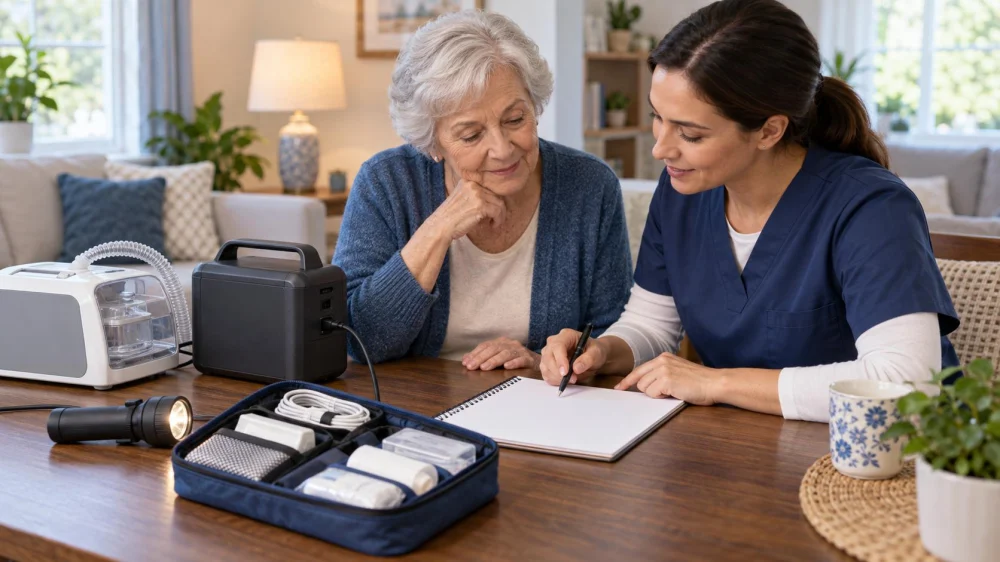
Home Care Device Power Outage: Contacts, Backup, and Handoff
On this page
Quick answer
List every essential home medical device, its power needs, battery runtime, supplier, clinical contact, and exact outage instructions. Keep approved batteries and supplies ready, enroll in available utility notifications, and practice the communication plan. If a life-sustaining device loses safe power or the person develops urgent symptoms, follow the care plan and call emergency services immediately.

Hospice Care Providers, Inc.
Rancho CucamongaSan Bernardino CountyCalifornia
9581 Business Center Dr building 12 suite h, Rancho Cucamonga, CA 91730, USA
Build a device inventory
For each device, record its name, model, purpose, normal power source, battery type, expected runtime, charging time, alarm meanings, and supplies required. Keep the current instructions for use close to the device and an accessible paper copy of essential details.
Ask the prescribing clinician or supplier which devices are life-sustaining, which may be paused, and which have time-sensitive consequences. Never make that judgment from appearance or battery percentage alone.

BrightStar Care
Rancho CucamongaSan Bernardino CountyCalifornia
9500 Haven Ave Suite 200B-2, Rancho Cucamonga, CA 91730, USA
Confirm contacts and escalation
List the home care agency, clinician, device supplier, manufacturer, electric utility, local emergency management, and emergency services. Include after-hours numbers and identify who calls each contact. Review consent and privacy rules before sharing medical details.
Tell the utility about qualifying medical equipment if it offers a registry or notification program, but do not treat enrollment as a guarantee of uninterrupted or priority restoration.
Verify approved backup power
Use only batteries, chargers, inverters, power stations, or generator arrangements approved for the specific device by its manufacturer or supplier. Label charged batteries, track replacement dates, and store them under the specified temperature and moisture conditions.
The FDA's home medical-device checklist recommends knowing what a device requires, keeping instructions nearby, maintaining a backup plan and supplies, and teaching caregivers how to use the equipment.
Respond during an outage
Note when power failed, check the person first, and follow the written device and clinical plan. Confirm alarms and remaining runtime without changing prescribed settings. Contact the designated supplier or clinician early rather than waiting until a battery is nearly empty.
FDA emergency guidance for medical devices advises keeping devices and supplies clean and dry, checking cords and batteries for damage, and seeking emergency services when a power-dependent device is needed to sustain life.
Check devices after power returns
Inspect cords, plugs, batteries, and the area for water or damage before reconnecting anything. Verify the manufacturer's restart procedure, alarms, clock, mode, and prescribed settings because some devices can reset after interruption.
Document outage duration, backup use, alarms, calls, symptoms, supply consumption, and any settings confirmed. Recharge or replace approved backup supplies and report unexpected behavior to the supplier and clinical team.
Important safety limits
Never run a fuel-burning generator indoors, in a garage, or near doors, windows, or vents. Do not use wet cords, improvised adapters, damaged batteries, overloaded power strips, or an unapproved power source. Oxygen and ignition sources require special precautions. Leave electrical repair and generator connection to qualified professionals.
Frequently asked questions
How much battery time is enough?
There is no universal answer. The clinical team and device supplier should define the required backup based on the device, person, local risk, and evacuation plan.
Will a utility medical registry prevent outages?
No. It may support communication or local programs, but every household still needs an independent backup and emergency plan.
Can any portable power station run a device?
No. Output, grounding, waveform, connectors, runtime, and manufacturer approval matter. Confirm compatibility before an emergency.
Should settings be checked after restoration?
Yes. Follow the device instructions because interruption may change clocks, modes, alarms, or default settings.
Sources and evidence notes
This plan uses FDA home-device and disaster guidance on inventories, backup supplies, contacts, caregiver training, moisture and cord checks, emergency escalation, and post-outage setting verification.
Next steps
Complete the device inventory with the clinician and supplier, verify approved backup power, print the contact list, and practice one outage scenario. After every drill or real outage, correct gaps and replenish supplies.






 Hospice Care Providers, Inc.5.0 (3 reviews)
 BrightStar Care0.0 (0 reviews)
 Allcare Homecare LLC5.0 (2 reviews)
 Optimal Senior Care Solutions5.0 (5 reviews)
 Ace Home Care5.0 (12 reviews)
 Canaan Home Care5.0 (12 reviews)
 Home Care Device Power Outage: Contacts, Backup, and Handoff
 Home Care Vision Change: Record, Reduce Hazards, and Call
 Home Care Intake Call: Define Scope Before the Appointment
 Home Care Completion Review: Test the Result Before Sign-Off
 Home Care Lighting Check: Glare, Switches, and Night Paths
 Home Care Shift Handoff: Changes, Tasks, and Follow-Up