
Choosing Everyday Clothing for Home Care: A Practical Guide
On this page
Quick answer
Choose home-care clothing with the person, not merely for them. Prioritize familiar style, comfortable fit, easy fasteners, safe footwear, appropriate warmth, and access needed for personal care or medical equipment. Offer a small number of suitable choices, allow enough time, and stop if dressing causes pain, breathing difficulty, distress, or a new skin problem. Ask the care team when needs change.
Adaptive clothing is clothing designed or modified to make dressing, undressing, movement, or care access easier. It can help some people, but it is not automatically better than familiar conventional clothing that already fits the person’s abilities and preferences.

Montrose Home Healthcare
GlendaleLos Angeles CountyCalifornia
230 N Maryland Ave # 209, Glendale, CA 91206, USA
Start with the person, not the garment
Clothing is part of identity and daily choice. Before replacing buttons, simplifying outfits, or reorganizing a closet, ask what the person likes to wear and what makes them feel ready for the day. A practical outfit should still look and feel like their own.
Use these conversation prompts:
- Which colors, fabrics, and styles feel most familiar?
- Does the person prefer to dress independently, receive reminders, or have hands-on help?
- Which fasteners are easy, frustrating, or painful to manage?
- Are there cultural, religious, work, social, or privacy preferences to respect?
- What activities, appointments, weather, and indoor temperatures are expected today?
Consent applies throughout dressing. Explain assistance before touching, protect privacy, and give the person time to respond. If they decline an outfit, look for the reason rather than treating the choice as a problem to overcome.

Recoup Home Health
BurbankLos Angeles CountyCalifornia
4421 W Riverside Dr Suite 204, Burbank, CA 91505, USA
Evaluate clothing for everyday use
Review each garment against the person’s current routine. The goal is not a perfect wardrobe; it is a reliable set of options that are comfortable, usable, and appropriate.
Fit and comfort
- Check that waistbands, cuffs, collars, socks, and undergarments do not dig into the skin.
- Look for rough seams, damaged fasteners, twisted fabric, or bulky layers that could create pressure.
- Allow room for ordinary movement without leaving long, loose fabric that could catch on equipment or drag underfoot.
- Recheck fit after a noticeable change in weight, swelling, posture, mobility, or equipment use.
Fasteners and openings
Large zipper pulls, elastic waists, front openings, magnetic closures, hook-and-loop fasteners, or open-back designs may reduce difficult hand movements. Choose based on the person’s abilities and care needs. Magnets may be inappropriate around certain medical devices, so verify device guidance before selecting magnetic clothing.
Fabric and temperature
Choose washable fabrics that feel acceptable on the skin and suit the environment. Layering can make temperature adjustment easier, but too many tight or heavy layers can limit movement. Do not assume an older adult feels cold or warm based only on age; ask and observe.
Footwear
Footwear should fit, remain secure on the foot, and suit the walking surface and mobility plan. Avoid improvised changes to prescribed footwear or orthoses. Worn soles, loose backs, curled insoles, and fasteners the person cannot manage are reasons to review the choice.
Care and equipment access
Clothing may need to accommodate braces, compression garments, continence products, monitoring equipment, tubes, or treatment access. Follow the care plan and equipment instructions. Never route, disconnect, compress, or conceal medical equipment simply to make clothing fit.
Build a manageable set of clothing options
A small, coordinated selection can support choice without creating a difficult search. Build it gradually using items the person already knows.
- Identify reliable favorites. Select several tops, bottoms, layers, undergarments, and footwear options that currently fit and are used willingly.
- Remove only with permission. Set aside damaged or unsuitable items for review; do not discard personal property without authorization.
- Create easy combinations. Group pieces that work together so the person can choose between complete outfits rather than solve many separate decisions.
- Make items visible. Use accessible drawers, open sections, or simple picture cues when helpful and approved. Avoid labels that expose health information.
- Separate special-purpose items. Keep sleepwear, appointment clothing, exercise items, and condition-specific garments in predictable locations.
- Test before buying more. Try one new fastener or garment style and learn from the person’s experience before replacing multiple items.
- Record practical details. Note sizes, preferred closures, fabric dislikes, and care instructions in the appropriate household or care record.
Best choices are the ones the person can and wants to use. An adaptive product that looks unfamiliar, feels undignified, or complicates laundry may not solve the actual problem.
Support a calm dressing routine
Prepare the room, the clothing, and the sequence before beginning. Make sure the space is private, comfortably warm, well lit, and free of trip hazards. Place stable seating where the care plan allows it.
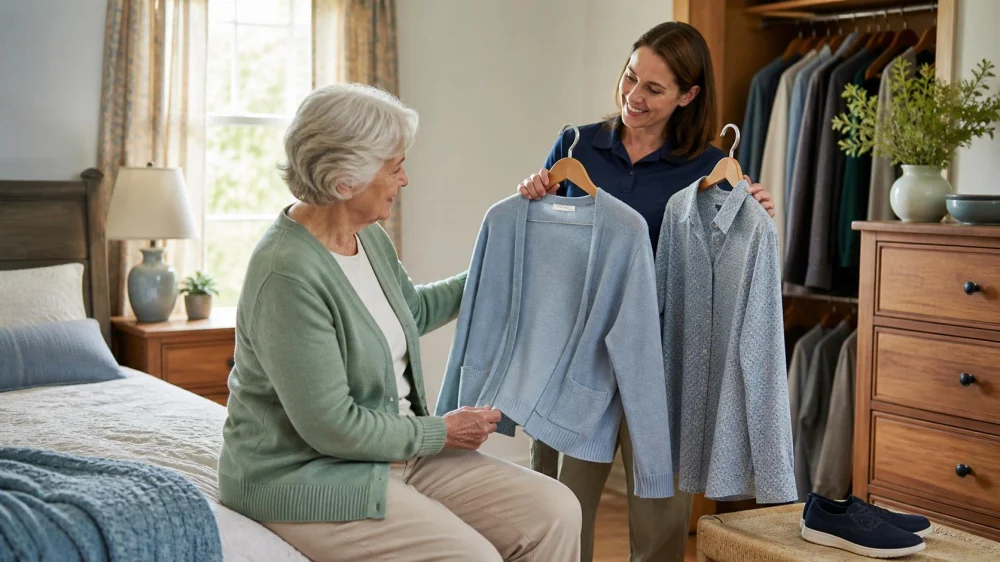
Offer two or three weather-appropriate choices rather than an entire closet. Lay garments in the order they will be used, but preserve opportunities for the person to do each step they can manage. Verbal cues, extra time, or positioning an opening may be enough; hands-on assistance should match the agreed support level.
Move joints only within the person’s comfortable and permitted range. Do not pull forcefully on an arm or leg, lift a person by their clothing, or use a garment as a transfer aid. Follow trained techniques for dressing around weakness, pain, or limited movement.
After dressing, check that fabric lies flat, fasteners are secure without pinching, footwear is fully on, and equipment remains correctly positioned. Ask the person how the outfit feels while sitting, standing, and moving as applicable.
When to pause and seek guidance
Stop the dressing task and follow the care or emergency plan when there is severe pain, sudden weakness, breathing difficulty, faintness, an acute change in alertness, or another urgent symptom. Do not continue merely to finish the outfit.
Request a non-urgent care-plan review when you notice:
- New swelling, persistent redness, broken skin, bruising, or pressure marks under clothing or footwear.
- Repeated difficulty using a previously manageable fastener or garment.
- Clothing that interferes with a brace, orthosis, compression item, tube, sensor, or other equipment.
- Frequent distress, refusal, or confusion connected with the dressing routine.
- A fit change that cannot be solved safely with available clothing.
- A need for dressing techniques or equipment the caregiver has not been trained to use.
An occupational therapist, physical therapist, nurse, or other qualified professional may help evaluate function, positioning, equipment, or adaptive strategies within their role. Clothing retailers can explain product features, but they do not replace clinical advice.
Limitations and important notes
- This is general U.S. home-care guidance, not a mobility assessment, skin assessment, or prescription for adaptive equipment.
- The person’s care plan, clinician instructions, equipment manuals, workplace policies, and garment labels take priority when more specific.
- Loose garments are not always easier or safer; excess fabric may catch on mobility aids, furniture, or equipment.
- Compression garments, orthoses, prostheses, and medically necessary footwear require the fitting and use instructions provided for that person.
- Do not alter clothing, install fasteners, or discard belongings without the owner’s consent or the authority defined in the care arrangement.
Sources and evidence notes
The guidance reflects broad person-centered home-care and dressing principles: preserve choice, support the person’s remaining abilities, reduce unnecessary physical effort, maintain privacy, and match garments to the environment, care plan, and equipment. Individual function and comfort can change, so repeated observation is more useful than assuming one clothing solution will remain suitable.
For specific decisions, use written care-plan directions, garment and equipment instructions, and recommendations from qualified members of the person’s care team. When purchasing adaptive clothing, verify the closure type, opening direction, fabric care, sizing method, return policy, and compatibility with any relevant equipment.
Frequently asked questions
Is adaptive clothing only for people with severe disabilities?
No. It may help anyone who finds ordinary dressing movements or fasteners difficult. The decision should be based on the person’s goals, comfort, abilities, and preferences rather than a label.
Are elastic waist pants always the easiest option?
They can reduce fastener steps, but they still need to fit safely and be manageable during dressing and personal care. A tight elastic waist or difficult pull-on motion may create a different problem.
How many clothing choices should a caregiver offer?
There is no fixed number. Two or three suitable options often make comparison easier, but the person may want more or fewer. Adjust the approach without removing meaningful choice.
Can a caregiver cut or modify clothing for easier access?
Only with proper consent and confidence that the change will be safe, durable, and compatible with care needs. A poorly secured fastener or rough cut edge can create new risks. Consider professional alteration when appropriate.
What if the person repeatedly chooses clothing that does not suit the weather?
Explain the current conditions, offer comfortable layers, and explore why the preferred item matters. Follow the care plan when decision-making support is addressed there, and raise recurring concerns with the authorized family member or care team without turning the interaction into a confrontation.
Next steps
Review five frequently worn outfits with the person receiving care. Check fit, fasteners, footwear, fabric comfort, equipment access, and laundry needs. Keep what works, note one specific dressing obstacle, and test the smallest respectful change. Share new pain, skin changes, mobility difficulty, or equipment conflicts through the established care process.






 Alpha1Care5.0 (8 reviews)
 Comfort Keepers Home Care4.0 (24 reviews)
 ASSISTALIFE HOME CARE1.0 (1 reviews)
 Nu Care5.0 (4 reviews)
 Home Instead Senior Care Services of Sherman Oaks, CA4.0 (25 reviews)
 Recoup Home Health5.0 (3 reviews)
 Exploring Long-Term Care Insurance Options for Seniors
 How to Foster Independence While Providing Necessary Home Care Support
 The Impact of Smart Home Technology on Senior Living: Enhancing Comfort and Safety
 Strategies for Encouraging Social Participation in Community Programs
 Creating a Personalized Care Plan for Your Aging Parent
 Strategies for Making Home Care Activities Enjoyable and Rewarding