
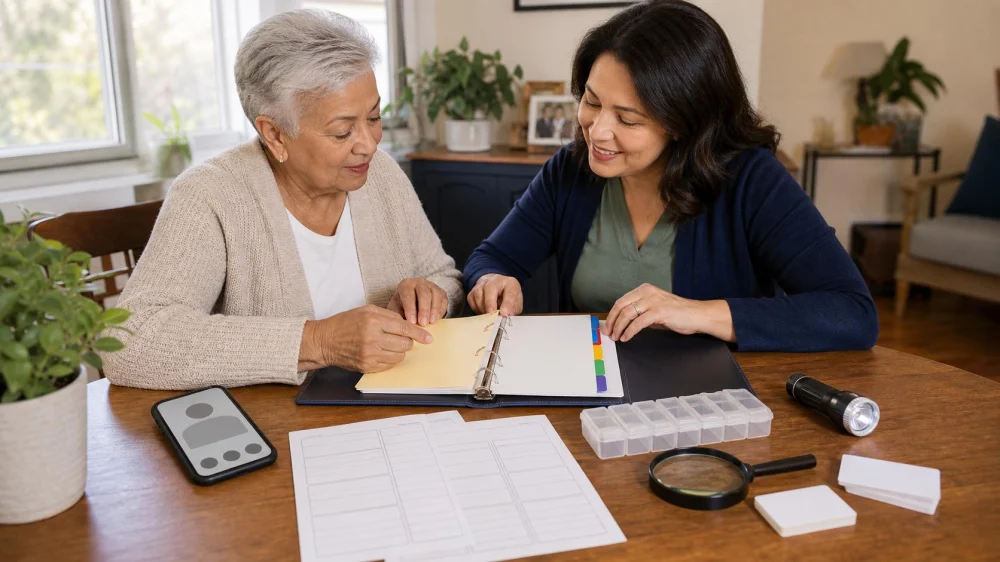
How to Build a Home Care Emergency Information Binder
In this guide
During an urgent handoff, evacuation, unexpected caregiver absence, or emergency-department visit, essential facts may be scattered across phones, pharmacy bottles, patient portals, and family members' memories. A home care emergency information binder gathers the minimum information another caregiver or responder needs to understand the person, continue essential routines, and reach the right professionals. It supports communication; it does not replace medical records, clinician instructions, or legal documents.

Affordable Caregivers
Los AlamitosOrange CountyCalifornia
3699 Katella Ave, Los Alamitos, CA 90720, USA
Quick answer
Build the binder around a one-page summary with the care recipient's identity, emergency contacts, conditions, allergies, medicines, communication and mobility needs, clinicians, preferred hospital, and immediate safety risks. Add sections for detailed medications, daily routines, equipment, insurance, advance-care and decision-making documents, emergency plans, and recent changes. Keep the binder in a known, secure, accessible place; maintain an encrypted or otherwise protected backup; and review it after every care transition or medication change and on a regular schedule.

South Bay Home Health Care - Retail Store
TorranceLos Angeles CountyCalifornia
1349 El Prado Ave, Torrance, CA 90501, USA
What the binder should accomplish
The binder should let an authorized backup caregiver answer five questions quickly:
- Who is the person and how do they communicate?
- What must happen safely in the next few hours?
- Which medicines, conditions, allergies, and devices matter?
- Whom should the caregiver call for clinical, family, or logistical help?
- Where are the source documents and current instructions?
The U.S. Centers for Disease Control and Prevention (CDC) advises that a care plan include identity and contact information, conditions, medicines with dosing details, healthcare providers, insurance, and emergency contacts. Use that as the foundation, then add the individual's functional and emergency needs.
Keep the binder usable under stress. A hundred unsorted pages are less helpful than a current two-page summary followed by clearly divided detail. Date every page so readers can see what may be stale.
Identity and emergency contacts
Place the care recipient's full legal name, preferred name, date of birth, home address, phone, preferred language, and communication method at the top of the first page. Add a recent photograph only with consent and if it would help identification during evacuation or wandering risk.
List contacts in priority order and label their role:
- primary family or legal decision-maker;
- backup family contact;
- primary-care clinician and key specialists;
- pharmacy;
- home health, hospice, personal-care agency, or care coordinator;
- medical-equipment supplier and after-hours number;
- preferred hospital and local emergency services information;
- neighbors or building staff authorized to assist.
Do not write “daughter” or “doctor” without a name and number. Specify who may receive health information and who has legal authority. Relationship, caregiving responsibility, and decision-making authority are not always the same.
Create a one-page health summary
Summarize active conditions in plain language, then note details that change emergency care: allergies and reactions, implanted devices, oxygen use, dialysis schedule, swallowing precautions, seizure plan, fall risk, cognitive impairment, baseline behavior, and infection-control needs. Record the person's usual level of function so responders can distinguish baseline from a new change.
Include communication needs such as hearing aids, glasses, speech device, interpreter, simple one-step directions, or a preference for yes/no questions. Document mobility and transfer requirements: independent, cane, walker, wheelchair, one-person assist, two-person assist, or mechanical lift according to the current professional care plan. Never invent a transfer method for the binder.
Use neutral, respectful descriptions. Instead of “confused,” record a useful baseline such as “usually knows familiar people and home; may not know date.” Note what typically calms distress and what can make it worse, without stereotyping the person.
Build a current medication list
For every prescription, over-the-counter medicine, vitamin, supplement, injection, inhaler, patch, cream, and as-needed product, list:
- generic and brand name when known;
- strength and dose;
- route and exact schedule;
- reason for use;
- prescriber;
- special instructions;
- date verified and person who verified it.
Separate scheduled and as-needed medicines. For an as-needed medicine, copy the authorized indication and limits from the current prescription or care plan rather than writing “give if needed.” Include known medication allergies and the reaction. Do not list a side effect as an allergy without clarifying what occurred.
The CDC recommends keeping a prescription list with diagnosis, dose, frequency, supply needs, and allergies for emergencies. Reconcile the binder against pharmacy and clinician records after hospital discharge, a specialist visit, or any reported change. Never change a dose based solely on an old binder page.
Document essential care routines
A backup caregiver needs critical tasks, not every personal preference on the first page. Create short checklists for morning, meals, toileting, skin care, mobility, bedtime, and overnight monitoring as applicable. Link each task to current professional instructions.
Record diet texture, fluid consistency, feeding support, food allergies, and aspiration precautions exactly as provided by the relevant clinician. Note continence products, catheter or ostomy care only at the level the backup caregiver is trained and authorized to perform. Include skin-risk areas, repositioning schedule, and wound-care contacts without asking an untrained person to perform skilled treatment.
Document routines that preserve dignity: preferred form of address, privacy needs, cultural or spiritual practices, and how the person likes choices presented. Add a brief “what helps” section for anxiety, dementia-related distress, or sensory overload.
List equipment and suppliers
Create an inventory of electricity- or battery-dependent medical and assistive devices, including oxygen concentrators, ventilators, positive-airway-pressure devices, suction pumps, feeding pumps, infusion pumps, home dialysis equipment, powered mobility, lifts, adjustable beds, hearing aids, and refrigeration needed for medicine. Not every household will use these.
For each item record the exact model, serial number if useful, supplier, after-hours service number, power requirement, battery type and runtime, approved backup method, and the clinician's contingency instructions. Store manuals with the equipment or link to a verified offline copy. Do not copy a generic emergency procedure from the internet onto a life-sustaining device page.
Add locations of walkers, transfer belts, charging cables, spare batteries, eyeglasses, hearing-aid supplies, and emergency kits. Label equipment physically only when doing so will not cover safety information or confuse components.
Organize legal and insurance details
Include copies—or a clear location record—of insurance cards, government identification, advance directive, healthcare power of attorney or proxy, portable medical orders when applicable, guardianship papers, and relevant consent forms. Legal names and requirements vary by state. Obtain documents through qualified legal and clinical guidance.
A binder label does not create legal authority. Identify the original document location and the person who holds it. If the care recipient has expressed preferences about emergency treatment, clinicians and authorized decision-makers should translate those wishes into the proper recognized documents.
Avoid storing Social Security numbers, banking credentials, passwords, or unnecessary financial records in a binder that caregivers regularly carry. Include only what is needed for care and emergency coordination.
Add the household emergency plan
Include two meeting locations, evacuation routes, transportation contacts, shelter considerations, local alert enrollment, and a communication plan. Mark whether the person can use a general population shelter or may need an accessible or medical setting. Confirm current local resources instead of assuming a facility will accept a particular device, caregiver, pet, or service animal.
List emergency supplies and their locations: medicines, water, specialty food, mobility aids, chargers, batteries, cooler and cold packs for refrigerated medicine, copies of documents, masks or other needed items, and comfort objects. CDC emergency guidance recommends planning around the individual's daily personal and medical needs.
Add separate short plans for power outage, extreme heat or cold, wildfire smoke, flood, severe weather, and caregiver interruption as locally relevant. Specify the trigger for leaving and who makes the call. “Evacuate if necessary” is too vague to guide a substitute caregiver.
Protect privacy without hiding access
The binder contains protected and sensitive information. Store it where authorized caregivers can reach it quickly but visitors, contractors, and casual helpers cannot browse it. A closed cabinet near the care area may work better than an obvious folder at the front door. Tell emergency contacts exactly where it is.
Create a secure digital backup using an approved encrypted system or protected device. Avoid emailing unencrypted copies broadly or storing them in a shared family album. Remove access when a caregiver's role ends. Ask the home-care agency and healthcare organizations how they exchange and retain information.
Some households keep a minimal emergency sheet in a sealed envelope for responders and the full binder elsewhere. Local responder programs and building policies vary; coordinate with authorized agencies rather than placing sensitive information in an unlocked public spot.
Create an update routine
Put a “last reviewed” date on the cover and every summary page. Review monthly or at another interval suitable for the person's changing needs, and immediately after:
- hospital admission or discharge;
- new diagnosis, allergy, or significant symptom;
- medicine start, stop, or dose change;
- equipment replacement;
- change in mobility, diet, cognition, or communication;
- new caregiver, agency, clinician, pharmacy, or insurance plan;
- move, travel, or change in emergency contacts.
Retire obsolete pages rather than leaving contradictory versions in different sections. If history must be kept, mark it clearly as archived and store it apart from current instructions. Ask a second caregiver to test the binder: can they find the medication list and after-hours number in less than a minute?
Common binder mistakes
- No visible review date: Readers cannot know whether the list is current.
- Medication names without dose or schedule: The list cannot support reconciliation.
- Legal authority left ambiguous: Family role is mistaken for decision-making authority.
- Too much narrative: Urgent facts are buried in long notes.
- Only one copy: The binder is unavailable during evacuation or loss.
- Too many copies: Old sensitive information remains on multiple phones and desks.
- Generic clinical directions: Internet advice replaces individualized orders.
Frequently asked questions
Should the binder travel to appointments?
A current summary and medication list are useful, but carrying the entire original binder may risk loss. Use a controlled appointment copy and update the master afterward.
Can a phone replace a paper binder?
A secure phone can be a backup, but batteries, access codes, damage, and network outages can block access. Many care teams benefit from both a protected paper source and a secure digital copy.
Who should update the medication list?
Assign one responsible person to reconcile changes with pharmacy, discharge, and clinician records. All caregivers should report changes, but one owner prevents competing versions.
Should passwords be included?
Do not place general account passwords in the binder. Use a secure password-management and authorized-access plan. Equipment access codes should be handled according to clinician and manufacturer guidance.
What belongs on the front page?
Identity, emergency contacts, allergies, high-priority conditions, current medicines or a pointer to the list, communication and mobility needs, immediate risks, and the last review date.
Make the first page do the most work
A useful emergency binder is current, concise at the front, detailed behind clear tabs, and protected without becoming unreachable. Start with the person, medicines, risks, contacts, and immediate routines. Add equipment, legal documents, insurance, and emergency plans, then assign an owner and review date. The binder's value is not measured by thickness. It is measured by whether an authorized backup caregiver can find the right fact and take the right next step when the usual caregiver is unavailable.






 Assistance In Home Care4.0 (11 reviews)
 Care Circle Home Health Agency5.0 (2 reviews)
 Integna Home Health0.0 (0 reviews)
 Home Hemo Professional, LLC4.0 (2 reviews)
 Life Start Home Health Care5.0 (1 reviews)
 Rose's Agency Home Care4.0 (16 reviews)
 Tips for Making Home Lighting Safe and Comfortable for Seniors
 Easy Gardening Activities That Promote Physical and Mental Health for Older Adults
 Tips for Balancing Work and Caregiving Responsibilities | HomeCare Hub
 The Importance of Cybersecurity in Home Health Care - HomeCare Hub
 The Importance of Physical Activity for Seniors and Healthy Aging
 Techniques for Reducing Fall Hazards in High-Traffic Areas of the Home