
Power Outage Planning for Home Caregivers
In this guide
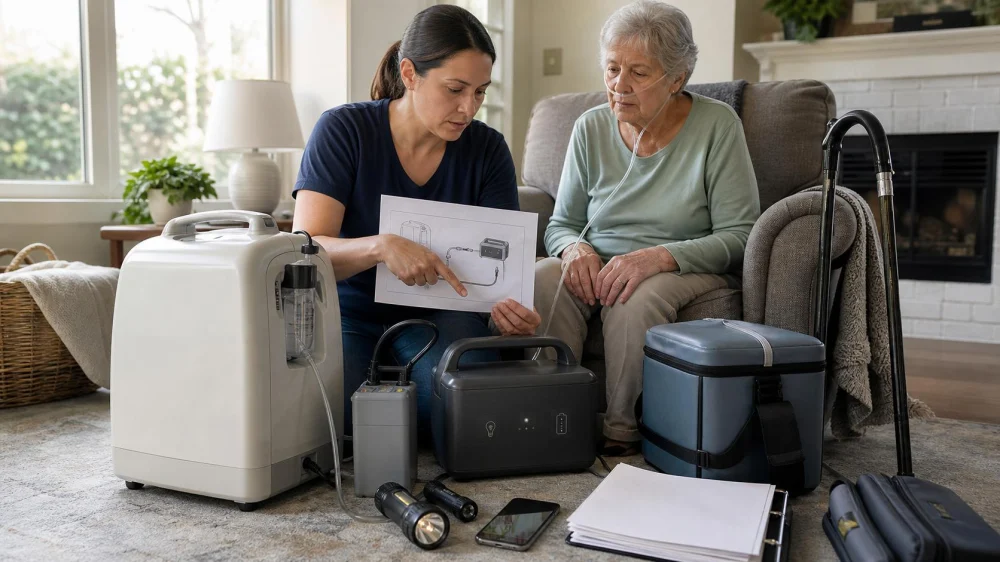
A power outage is inconvenient for most households and potentially life-threatening for someone who depends on an oxygen concentrator, ventilator, suction pump, feeding or infusion pump, home dialysis equipment, powered wheelchair, lift, adjustable bed, refrigerated medicine, or temperature-controlled environment. A useful caregiver plan is built before the forecast turns severe. It matches each device to an approved backup, converts battery runtime into decision points, and identifies a destination that can actually meet the person's needs.

Quick answer
List every electricity- and battery-dependent device, its power requirements, battery runtime, approved backup, supplier, and clinical contingency instructions. Ask the prescribing clinician and equipment provider what to do if power stops and when to call emergency services or relocate. Register for utility and local emergency programs where available, but do not rely on priority restoration. Keep charged batteries, lighting, communications, medicines, documents, transportation, and an accessible destination ready. Never run a generator, grill, or fuel-burning device indoors or near doors, windows, or vents.

Shirell's Home Care Changing Lives LLC
OntarioSan Bernardino CountyCalifornia
3281 E Guasti Rd Suite #700, Ontario, CA 91761, USA
Make a power-dependence inventory
Walk through an ordinary day and night. Record not only life-sustaining equipment but every powered item needed for safe care:
- ventilator, oxygen concentrator, positive-airway-pressure device, or nebulizer;
- suction, infusion, enteral-feeding, or home dialysis equipment;
- powered wheelchair or scooter and transfer lift;
- adjustable bed, pressure-relief surface, and communication device;
- hearing-aid or cochlear-implant chargers;
- refrigerator for medicine or special nutrition;
- well pump, stair lift, garage door, elevator, and building-access system;
- heating, cooling, air filtration, and smoke or carbon-monoxide alarms.
For each item, copy the model, serial number, supplier, after-hours phone, input voltage and wattage, battery chemistry, typical and minimum runtime, charging time, compatible backup, and maintenance date. The label wattage and actual operating load may differ; obtain specifications from the manufacturer or supplier rather than estimating.
Mark which device cannot be interrupted, which can pause under a clinician-approved plan, and which affects comfort rather than immediate safety. This ranking guides what receives limited backup power first.
Get device-specific clinical instructions
Contact the clinician who manages the underlying condition and the durable medical equipment provider. Ask for a written outage plan that addresses:
- how long the person can safely be without the device, if at all;
- approved manual, battery, tank, or alternate-device backup;
- signs that the backup is not meeting the person's needs;
- when to call the clinical team, supplier, 911, or another emergency number;
- when to relocate before batteries are depleted;
- how to travel with the device and supplies;
- what settings must never be changed by a caregiver.
Do not invent a lower setting to extend runtime, substitute a consumer battery, or switch from an oxygen concentrator to a tank without individualized instructions and compatible equipment. A caregiver should be trained hands-on before an emergency, then practice the approved transition while the primary system is working.
Place the plan with the device, in the emergency binder, and in the go kit. Ensure backup caregivers can find and follow it. If power loss creates an immediate threat and the approved backup is unavailable or failing, call 911 in the United States.
Plan backup power and charging
Backup options may include manufacturer-approved batteries, an uninterruptible power supply, a correctly sized portable power station, a permanently installed standby system, or a properly operated portable generator. Compatibility is device-specific. Medical equipment can have startup loads, grounding, waveform, alarm, and charging requirements that make a seemingly adequate consumer product unsuitable.
Ask the equipment supplier and a qualified electrician to evaluate the setup. Calculate runtime using verified load and usable battery capacity, then test under safe supervised conditions. Batteries lose capacity with age, temperature, storage, and repeated use, so a runtime measured years ago may no longer be reliable.
Label each battery with the device, purchase date, service schedule, and last full test. Rotate and charge it per manufacturer instructions. Keep cables together and prevent incompatible connectors from being mixed. Do not store lithium batteries where they can be crushed, overheated, submerged, or exposed to damaged terminals.
Create a power budget. Life-sustaining equipment comes before entertainment or household conveniences. Lighting, phone communication, and refrigeration may also be essential, but every added load shortens runtime.
Coordinate with utilities and local resources
Ask the electric utility whether it maintains a medical needs, life-support, or critical-care customer program and what documentation it requires. Enrollment may support outage communication or restoration planning, but it does not guarantee uninterrupted power or first restoration. Keep an independent backup and relocation plan.
Enroll in local emergency alerts and identify the emergency-management, public-health, fire, and nonemergency transport contacts relevant to the household. The HHS emPOWER Program highlights the risks prolonged outages create for millions of people who rely on electricity-dependent durable medical and assistive equipment. Community planning uses this information, but an individual caregiver still needs a specific plan.
Call prospective shelters, cooling or warming centers, hotels, family homes, dialysis centers, and charging sites in advance. Confirm accessibility, hours, electrical capacity, outlet policy, refrigeration, oxygen rules, service-animal accommodation, caregiver access, infection precautions, and whether medical support is actually provided. A public charging station may charge a phone but be unsuitable for a life-sustaining device.
Protect medicines and temperature-sensitive supplies
Ask the pharmacist how each temperature-sensitive medicine should be stored during an outage, how long it remains usable outside the labeled range, and what to do if temperature history is uncertain. Do not freeze medicines against loose ice or assume a household refrigerator remains safe for a fixed number of hours under every condition.
Keep an appliance thermometer in the refrigerator and a cooler with chemical cold packs ready if the pharmacist recommends that method. Open the refrigerator and freezer as little as possible. Separate medicine from food spills and protect it from direct contact with ice or water. Record outage start, refrigerator temperature, and any transfer time.
CDC emergency guidance recommends organizing prescriptions, asking clinicians or pharmacists about an emergency supply where allowed, keeping an accurate medication list, and planning a cooler and cold packs for refrigerated medicines. Refill rules vary by state, plan, drug, and emergency declaration, so discuss them before supplies run low.
Never use a medicine that looks damaged or whose storage safety is uncertain without pharmacist guidance. Do not discard it until the pharmacist or insurer explains replacement and documentation requirements.
Prepare the home for darkness and temperature changes
Place battery lighting along the route between bed, bathroom, exit, equipment, and supplies. Avoid candles because of fire risk, oxygen use, cognitive impairment, and unstable movement. Keep flashlights within reach and use models the care recipient can operate.
Clear floors before severe weather, secure cords, and mark level changes with high contrast where appropriate. A powered lift or bed may stop in an unsafe position, so know the manufacturer-approved manual release and ensure caregivers are trained. Never attempt an untrained manual transfer because the lift lacks power.
Indoor temperature can become dangerous during prolonged heat or cold. The care recipient's conditions and medicines may increase vulnerability. Identify relocation thresholds with clinicians and public-health guidance; do not wait for visible distress. Battery fans do not prevent heat illness in all circumstances, and fuel-burning heaters introduce fire and carbon-monoxide hazards.
Keep working battery-backed smoke and carbon-monoxide alarms on every required level and near sleeping areas according to local code and manufacturer instructions. Test them regularly.
Use generators and fuel safely
Portable generators produce carbon monoxide, an invisible, odorless gas that can kill quickly. Operate a generator only outdoors, far from doors, windows, vents, garages, carports, crawlspaces, and other openings, following manufacturer and public-safety distance instructions. Never run it in a home, garage, basement, shed, tent, or partially enclosed area—even with doors open.
A qualified electrician should install any transfer switch or permanent connection. Never “backfeed” a house by connecting a generator to a wall outlet. This can electrocute utility workers and neighbors and can cause fire. Use only outdoor-rated cords of the correct gauge and condition when permitted, protect connections from water without enclosing the generator, and keep the unit dry according to its manual.
Turn the generator off and let it cool before refueling. Store fuel in approved containers away from living areas, ignition sources, oxygen equipment, and children. Follow local fire codes and fuel-storage limits. A caregiver who cannot operate the generator safely needs a different backup plan, not a rushed lesson during a storm.
What to do when power fails
- Note the time. Start the battery and medication-temperature timeline.
- Check the person first. Assess according to the individualized care plan and respond to alarms.
- Switch to the approved backup. Follow trained steps without changing clinical settings.
- Reduce nonessential loads. Preserve power for critical devices, communication, lighting, and approved refrigeration.
- Confirm outage scope and estimate. Use utility channels and alerts, recognizing estimates can change.
- Contact the support network. Tell the backup caregiver, supplier, clinician, and transportation contact as the plan specifies.
- Recalculate the decision time. Use current battery status and realistic travel time, not the best-case published runtime.
- Relocate early if needed. Do not use the last battery reserve while deciding.
Keep a written log of device alarms, battery changes, oxygen tank use, medicine temperatures, symptoms, calls, and instructions. One caregiver should coordinate the plan so tasks are not duplicated or assumed complete.
Know when and where to relocate
Relocation criteria should be concrete: battery reaches a defined reserve, indoor temperature crosses the clinician-approved threshold, oxygen supply falls below the travel and contingency amount, the utility estimate exceeds safe runtime, or a caregiver cannot continue essential tasks. Include travel time, loading time, traffic, elevators, weather, and destination check-in.
Pack the device, approved backup, charger, extension or power accessories allowed by the supplier, medications, cooling supplies, care summary, settings, prescriptions, insurance information, mobility aids, continence and feeding supplies, and comfort items. Keep fuel, oxygen, and batteries secured according to transportation rules.
Call the destination before leaving to verify power and capacity. A hospital emergency department should not be used merely as a charging location, but it is appropriate when the person's health is threatened or the emergency plan directs it. Call 911 for immediate danger or when safe transport cannot be provided.
Recover and restock after power returns
Stable utility power may return in stages. Check the utility notice and inspect for damaged cords, water intrusion, burning odor, sparks, or abnormal voltage signs before reconnecting. If anything appears unsafe, stay clear and contact the utility or electrician.
Recharge and test batteries, replenish oxygen or consumables, refuel safely, and reset clocks and alarms according to device instructions. Ask the pharmacist about medicines exposed to uncertain temperatures. Document discarded and replaced supplies for insurance or assistance programs.
Review the event within a few days. Compare estimated and actual runtime, missed calls, transport delays, difficult transfers, and unused supplies. Update the plan while details are fresh and share changes with every caregiver.
Common planning mistakes
- Relying on medical-priority enrollment: It does not create guaranteed power.
- Using nameplate runtime as a promise: Battery age, load, and temperature reduce performance.
- Planning to decide when the battery is nearly empty: Relocation needs a reserve.
- Buying a power station without compatibility review: Capacity alone does not prove suitability.
- Keeping generator fuel but no trained operator: Equipment is not a plan without safe use.
- Assuming a shelter supports medical devices: Confirm before the emergency.
- Forgetting night and weekend contacts: Supplier and clinical offices may use different after-hours routes.
Frequently asked questions
Will the electric company restore power first for medical needs?
Programs vary, and enrollment may help communication or planning, but utilities generally cannot guarantee continuous service or a precise restoration order. Maintain backup power and relocation options.
Can I plug medical equipment into any portable battery?
No. Confirm voltage, power, waveform, grounding, startup load, charger, and manufacturer approval with the equipment provider and qualified electrical professional.
How many backup batteries are enough?
The answer depends on clinical urgency, load, verified runtime, outage history, travel time, and replacement charging. Build a clinician- and supplier-reviewed timeline rather than using a universal count.
Can a gas stove heat the home?
No. Never use an oven, range, grill, or other cooking appliance to heat a home. It creates carbon-monoxide and fire hazards.
What if the person refuses to relocate?
Discuss preferences, capacity, legal authority, and triggers before an emergency with the person, clinicians, and authorized decision-makers. During immediate danger, call emergency services for guidance rather than attempting unsafe force or delay.
Turn runtime into a decision timeline
The core of outage planning is not owning the most batteries. It is knowing what each device supports, how long its verified backup lasts, which warning signs matter, whom to call, and when to leave while safe options remain. Build the inventory with clinicians, suppliers, utilities, and local emergency resources; practice the transition; and review every outage. When runtime becomes a timeline with clear decisions, caregivers can act earlier and protect the person instead of improvising in the dark.






 Assistance In Home Care4.0 (11 reviews)
 Care Circle Home Health Agency5.0 (2 reviews)
 Integna Home Health0.0 (0 reviews)
 Home Hemo Professional, LLC4.0 (2 reviews)
 Life Start Home Health Care5.0 (1 reviews)
 Rose's Agency Home Care4.0 (16 reviews)
 Tips for Making Home Lighting Safe and Comfortable for Seniors
 Easy Gardening Activities That Promote Physical and Mental Health for Older Adults
 Tips for Balancing Work and Caregiving Responsibilities | HomeCare Hub
 The Importance of Cybersecurity in Home Health Care - HomeCare Hub
 The Importance of Physical Activity for Seniors and Healthy Aging
 Techniques for Reducing Fall Hazards in High-Traffic Areas of the Home