
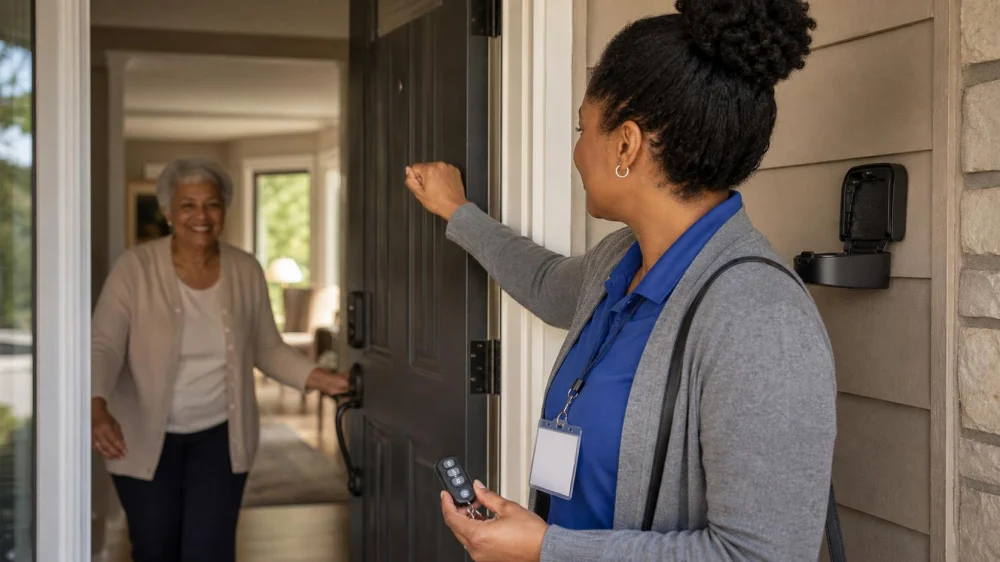
Home Care Key and Entry Plan: Access Without Losing Privacy
On this page
Quick answer
A home care entry plan should state who may enter, during which scheduled window, by what method, and what to do if no one answers. Use the least access needed, keep codes and keys in a controlled register, announce arrival, protect private rooms, and revoke access promptly when care arrangements change. Emergency responders need a separate, locally appropriate plan.

The Immortelle Med Healthcare Group: Post-Surgery Care & Home Health Services
Los AngelesLos Angeles CountyCalifornia
300 S Doheny Dr, Los Angeles, CA 90048, USA
Start with consent and authority
Build the plan with the person receiving care whenever possible. Ask how they want visitors to knock, call, announce themselves, and enter. Identify any rooms, cabinets, devices, or records that remain private. Care needs do not erase the person’s dignity or control over their home.
Record who has legal or contractual authority to authorize access when the person cannot do so. A relative, neighbour, landlord, agency, property manager, and health proxy can have different roles. Do not assume that a medical decision-maker automatically controls leases, keys, or property. Check the actual documents and local rules.

Seniors Helping Seniors Huntington Beach
Huntington BeachOrange CountyCalifornia
17011 Beach Blvd #900, Huntington Beach, CA 92647, USA
Choose an entry method
Options include the resident opening the door, an assigned family member, a numbered key, a lockbox, a keypad code, a smart lock, or building staff. Compare reliability during power or internet loss, accessibility, audit history, battery replacement, weather exposure, building approval, and what happens if the device fails.
A hidden spare key is easy to copy or discover and creates no access record. A lockbox should be securely installed, positioned for safe use, and approved by the property owner or association when required. Never label a key with a full address or the resident’s name. Use an internal identifier that means nothing outside the register.
Control codes and keys
Create a register listing each key or credential, issue date, recipient, purpose, return date, and status. Store the register separately from the keys. Give each worker only the access required for assigned visits. Do not share codes through group messages or write them in open calendar notes.
Use agency-approved secure systems for transmission and storage. Prohibit copying unless specifically authorized. Ask how the provider screens workers, audits access, handles lost devices, and reports departures. Smart-lock logs can support review, but they should not become unnecessary surveillance; decide who may see them and how long they are retained.
Create an arrival routine
Set an expected arrival window and whether the caregiver calls before travel. At the door, knock or ring, wait the agreed time, identify the agency and caregiver, then announce entry again after unlocking. Wear agreed identification without displaying sensitive health information to neighbours.
Relock the door immediately unless the resident requests otherwise and it is safe. Return the key to its secure location; never leave it in the exterior lock. If other visitors, contractors, or family members are present, follow the resident’s visitor and privacy plan rather than assuming they may observe care.
Plan for failed entry
A caregiver who cannot enter should not improvise by climbing, forcing a door, or asking an unknown neighbour for access. The plan should list call order, waiting time, agency supervisor, authorized contact, building management, and circumstances for requesting a welfare check or emergency response.
Distinguish an ordinary scheduling problem from signs of danger. An unanswered door after a cancelled visit differs from no response when the person is expected home and has a known immediate risk. Workers should describe observable facts to the supervisor and emergency service rather than making a diagnosis.
End or change access safely
When a worker, agency, or service ends, collect physical keys and disable credentials promptly. Confirm return in writing and update the register. Change a code rather than relying on a promise not to use it. If a key is lost or cannot be accounted for, notify the authorized person and assess rekeying based on risk.
Review access after a move, hospitalization, new roommate, staffing change, suspected misuse, or security incident. Preserve relevant logs and reports without circulating them broadly. Report theft, exploitation, stalking, or immediate danger through the appropriate agency, adult-protection, law-enforcement, or emergency channel in the jurisdiction.
Frequently asked questions
Should every caregiver have the same door code?
Individual credentials are preferable when the system supports them because they can be revoked and audited separately. Shared codes require stricter change and distribution controls.
Can a lockbox be attached to a rental property?
Only with the approvals required by the lease, owner, building, fire rules, and local law. Ask where it may be installed and who may hold the combination.
What if the person changes their mind about entry?
Respect current consent unless an authorized emergency or legal arrangement applies. Pause, contact the supervisor, and clarify rather than forcing routine care.
Evidence and limitations
This checklist applies privacy, least-access, credential-control, incident-reporting, and person-directed care principles. It does not determine legal authority, tenancy rights, emergency entry powers, or agency obligations. Contracts, care plans, property rules, and state or local law control a specific home.
Conclusion and next steps
Write who authorizes entry, which method is used, how arrival is announced, and what happens after failed access. Inventory every credential and revoke it when roles change. Review the plan with the person receiving care, the provider, and authorized contacts before the first unsupervised visit.






 Right at Home5.0 (10 reviews)
 Practicare Home Health Inc5.0 (2 reviews)
 Aletheia Home Care0.0 (0 reviews)
 Direct Care Home Health Inc.5.0 (9 reviews)
 Visiting Angels5.0 (42 reviews)
 Regency Palms Long Beach4.0 (20 reviews)
 How to Encourage Creative Expression Through Art and Craft Projects
 Tips for Encouraging Safe and Fun Outdoor Activities for Aging Loved Ones | HomeCare Hub
 Innovations in Home Care Technology: Enhancing Quality of Life
 Strategies for Promoting a Sense of Autonomy and Choice for Older Adults
 How to Teach and Encourage Healthy Lifestyle Habits in Aging Loved Ones
 How to Create a Morning Routine That Energizes Aging Loved Ones