
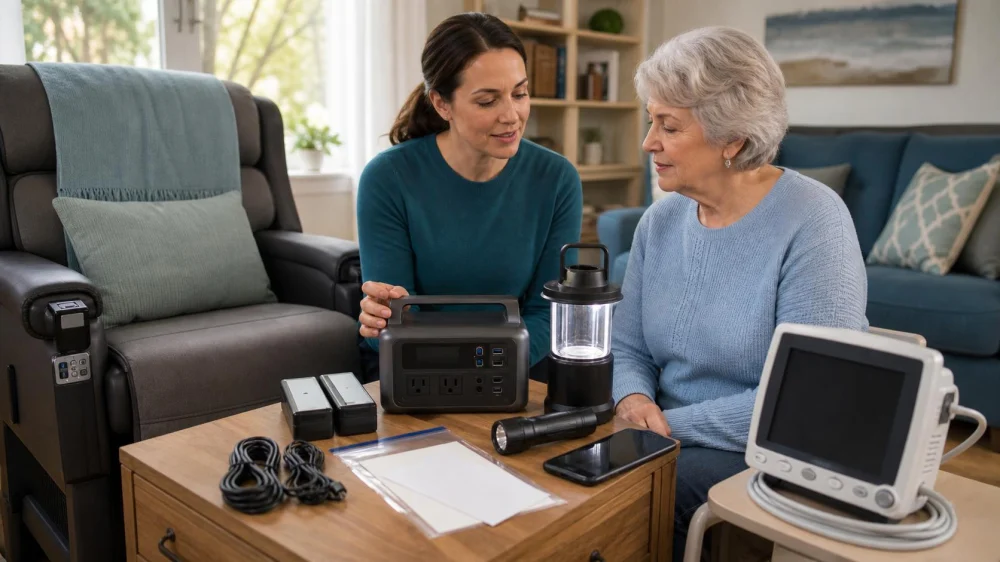
Home Care Power Outage Plan: Devices, Contacts, and Backup
On this page
Quick answer
A home care power outage plan must identify every device that uses electricity, the safe backup approved for that exact device, how long backup power is expected to last, who to call, and where the person can go before power runs out. If a device is life-sustaining or the person develops breathing trouble, loss of consciousness, severe symptoms, or device failure, call emergency services immediately.
This guide is for US households coordinating home care. The prescribing clinician, device manufacturer, distributor, home care agency, electric utility, and local emergency officials must help create the individual plan. Never improvise a power connection or change device settings from general online advice.

Build a device and power inventory
List every item whose loss would affect breathing, mobility, communication, medication, nutrition, temperature control, monitoring, or safe transfer.
- Device name, brand, model, serial number, and prescribing or supervising clinician.
- Manufacturer and distributor support numbers, including after-hours contacts.
- Normal power source, plug type, voltage information, and approved backup options from the user manual.
- Battery type, stated runtime, age, replacement date, charging time, and how remaining charge is displayed.
- Settings that must be recorded and checked after power returns.
- Supplies that do not use power but are needed to operate, clean, or safely stop the device.
- Environmental limits for heat, cold, humidity, water exposure, and storage.
Include supporting equipment such as a powered bed, lift, suction device, oxygen concentrator, feeding pump, communication device, refrigeration for a specific product, internet router, or charging station only when it is actually part of the person’s care.
Keep one printed copy of the inventory in a waterproof sleeve and one digital copy available to caregivers. Do not post serial numbers or health details publicly.

Seniors Helping Seniors® Orange
333 City Blvd W # 300, Orange, CA 92868, USA
Create a contact and evacuation plan
Arrange help before an outage. A contact list should state who makes each decision, not just provide phone numbers.
- Emergency services: Call 911 for immediate danger, life-sustaining device failure, or severe symptoms.
- Health care team: Ask which changes require a clinical call and what to do if the device cannot run normally.
- Device manufacturer or distributor: Confirm approved batteries, charging, transport, alarms, and backup equipment.
- Home care agency: Define how visits, handoffs, supplies, and staffing change during an outage.
- Electric utility: Ask about medical-need notification or outage programs, while understanding that enrollment may not guarantee uninterrupted or faster restoration.
- Local emergency management: Learn how alerts, shelters, accessible transportation, and evacuation support work locally.
- Backup location: Identify an accessible site with confirmed compatible power and the ability to support the person’s care.
Plan two transportation options and decide who brings devices, batteries, prescriptions, supplies, records, mobility equipment, and communication tools. Do not wait until the last battery is nearly empty to decide where to go.
Prepare backup power safely
- Use only approved power sources. Check the device manual and ask the manufacturer or distributor whether batteries, an uninterruptible power supply, vehicle power, or a generator is compatible.
- Test under professional guidance. Learn how the device indicates battery mode, remaining time, low power, and failure. Do not test by disconnecting a critical device from needed power.
- Charge on schedule. Keep approved batteries charged, labeled, dry, and within their storage temperature limits.
- Track maintenance. Record battery age, test dates, expected replacement, and any decrease in runtime.
- Protect cords and equipment. Keep devices off the floor and away from water, pets, crowded pathways, and damaged outlets.
- Prepare lighting. Use battery flashlights or lanterns. Where oxygen is in use, avoid flames, candles, gas lights, and sparks.
- Plan for communication. Keep phones, backup communication devices, and approved power banks charged; maintain printed contacts in case internet service fails.
A portable generator introduces deadly carbon monoxide, fire, shock, and connection hazards. It must be selected, placed, fueled, and connected according to the manufacturer, local codes, utility rules, and qualified professional guidance. Never operate one in a home, garage, basement, shed, enclosed area, or near openings.
What to do when power fails
- Assess the person first. Call emergency services for severe symptoms, immediate danger, or loss of a life-sustaining function.
- Switch only as trained. Use the approved backup procedure for the exact device. Do not silence unexplained alarms or change prescribed settings.
- Start the clock. Record when power failed, the battery level, estimated runtime, and when evacuation must begin.
- Report the outage. Contact the utility through its official channel and note the outage number and estimate, while planning for estimates to change.
- Call the care network. Notify the health care team, agency, distributor, and designated support people according to the plan.
- Protect devices. Keep equipment dry, clean, ventilated as designed, and away from unsafe heat, humidity, and improvised cords.
- Leave early if needed. Move to the confirmed backup location before the safe power margin is exhausted.
After power returns, check cords and devices for moisture or damage before plugging them in. Confirm that settings did not reset and follow the manufacturer’s restart procedure. Report alarms, unusual performance, damaged supplies, or uncertain settings to the appropriate professional.
Critical limits and emergency triggers
Life-sustaining devices: The FDA advises people who depend on a device to stay alive to seek emergency services immediately during a device-threatening emergency. Do not rely only on a utility restoration estimate.
Wet equipment: Never plug in a wet cord or device. If electrical equipment or circuits have been exposed to water, keep away and obtain qualified help.
Oxygen: Keep oxygen away from flame, smoking, sparks, and unsuitable electrical equipment. Use battery lighting rather than candles. Follow the oxygen supplier’s emergency instructions.
Refrigerated items: A household refrigerator thermometer or room temperature alone cannot determine whether a specific medicine, device, or supply remains usable. Follow manufacturer, pharmacist, clinician, or FDA instructions for that product.
Caregiver limits: A caregiver should perform only tasks included in the care plan and their training. When the plan does not cover the situation, escalate rather than improvise.
Sources and evidence notes
The US Food and Drug Administration advises device users to prepare for power loss, moisture, contamination, and supply disruption. See the FDA’s emergency information for medical devices.
The FDA’s consumer disaster guidance recommends reading device instructions, contacting the manufacturer or distributor about batteries and generators, keeping devices dry, checking settings after power returns, and seeking emergency services immediately when a life-sustaining device is threatened. See FDA tips for medical devices during disasters.
These sources provide broad safety principles. The exact device instructions and individual clinical plan determine safe backup, runtime, transport, and escalation.
Frequently asked questions
Will the electric utility restore power first for a medical need?
Do not assume it will. Ask the utility about its current medical-notification program and what it does and does not provide. Maintain independent backup and evacuation plans.
Can I use any power bank or battery station?
No. Output, waveform, grounding, connector, capacity, and device requirements vary. Use only a source approved for the exact device by its manufacturer or qualified professional.
How much battery time is enough?
There is no universal duration. Outage length, device load, battery age, charging, travel time, and clinical risk matter. The care team and manufacturer should help set a safe departure threshold.
Should we wait for a utility restoration estimate?
An estimate can change and should not replace the care plan. Start the backup clock immediately and leave early enough to preserve a safe margin.
What should be checked after power returns?
Check for water or damage, follow the restart instructions, verify settings, confirm normal alarms and performance, recharge approved batteries, and document the event. Contact support if anything is uncertain.
Conclusion and next steps
Inventory each powered device, obtain its approved backup instructions, test the communication chain, and choose an accessible place to go before batteries run low. Print the plan, maintain batteries, and review it with every caregiver. During an outage, assess the person first, use only trained procedures, start the backup clock, and call emergency services whenever a life-sustaining function or the person’s condition is at risk.






 AVERY CARE HOME HEALTH, INC0.0 (0 reviews)
 Coastal Home Care0.0 (0 reviews)
 Unique Touch Home Healthcare5.0 (14 reviews)
 CGT Home Care5.0 (20 reviews)
 Healthways Home Health Services, Inc.4.0 (51 reviews)
 Best For Family Home Care LLC5.0 (26 reviews)
 Understanding the Risks of Polypharmacy in Older Adults
 The Importance of Routine in Dementia Care
 Tips for Helping Seniors Maintain Healthy Eating and Hydration Habits
 Effective Communication Strategies for Dementia Care – Improve Care and Support
 Ideas for Creating a Comfortable and Stimulating Living Environment for Seniors
 How to Encourage Social Engagement Through Hobbies and Clubs