
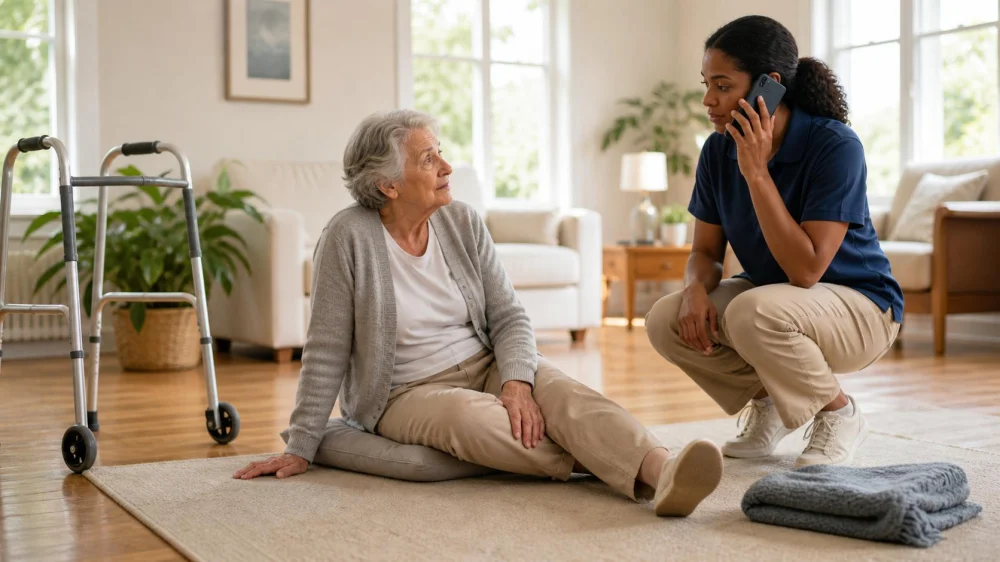
Home Care Fall Response: Stay, Assess, and Call for Help
On this page
- Quick answer
- Make the scene safe
- Check response, breathing, and major bleeding
- Do not rush to lift the person
- Recognize emergency signs
- Support a safe self-directed rise
- Document and report the fall
- Arrange a post-fall review
- Home care fall checklist
- Frequently asked questions
- Sources and evidence notes
- Conclusion and next steps
Quick answer
After a fall in home care, stay calm, make the area safe, obtain consent when possible, and check whether the person responds, breathes normally, and has life-threatening bleeding. Call 911 for an unresponsive person, abnormal or absent breathing, severe bleeding, suspected head, neck, back, pelvis, hip or major limb injury, severe pain, signs of shock, or any condition that exceeds the care plan or caregiver’s training.
Do not grab the person under the arms or pull them up quickly. Leave them in the position found when head, neck, back, pelvic or serious injury is possible, unless movement is required for immediate safety, CPR, or bleeding control. Stay with them, keep them comfortable, and follow dispatcher instructions.

Sunset Home Health Care
West HollywoodLos Angeles CountyCalifornia
8285 Sunset Blvd Ste #9, West Hollywood, CA 90046, USA
Make the scene safe
Pause before approaching. Look for water, broken glass, electrical cords, spilled medication, a hot surface, unstable furniture, a fallen mobility aid, pets, or traffic through the room. Prevent another person from slipping without moving the fallen person unnecessarily.
Introduce yourself, explain what you are doing, and ask permission when the person can respond. Put on appropriate protective equipment if blood or body fluid is present. Note the position and surroundings because they may help clinicians understand what happened, but do not delay emergency care to take photos.

Check response, breathing, and major bleeding
Use your first-aid training: check responsiveness, normal breathing, and life-threatening bleeding. If the person does not respond, is not fully awake, is not breathing normally or is only gasping, or has life-threatening bleeding, call 911 and provide CPR, AED use, or bleeding care within your training and the dispatcher’s direction.
For a responsive person, ask what hurts, whether the head struck anything, whether they feel dizzy, faint, weak, numb, short of breath, or different from usual, and whether they can move without pain. Ask about blood-thinning medication and relevant conditions if this information is not already in the care plan. Do not ask them to move an area that causes pain.
Do not rush to lift the person
A well-intended lift can worsen an injury and injure the caregiver. The American Red Cross advises treating muscle, bone, and joint injuries as potential fractures and leaving a person with suspected head, neck, or back injury in the position found unless movement is essential for safety, CPR, or bleeding control.
Do not drag, pivot, or use furniture as a lifting device. Do not improvise with a towel or transfer belt unless that exact method is in the person’s plan and the caregiver is trained and authorized. A mechanical lift requires the correct equipment, sling, number of trained helpers, and a care plan; it is not an emergency substitute for assessment.
Recognize emergency signs
Call 911 for loss of consciousness, confusion, seizure, new severe headache, repeated vomiting, unequal pupils, weakness or numbness, trouble speaking, breathing difficulty, chest pain, uncontrolled bleeding, deformity, a shortened or rotated leg, inability to bear weight, severe or increasing pain, signs of shock, or a significant fall mechanism.
Also escalate when the person takes an anticoagulant or antiplatelet medicine and may have struck the head, according to their clinician’s emergency plan. Symptoms of internal or head injury can be delayed. When uncertain, contact emergency services or the designated clinical line rather than declaring the fall harmless.
Support a safe self-directed rise
If the person is fully alert, reports no injury, can move without pain, and wants to get up, follow their established fall-recovery plan. The National Institute on Aging describes a self-directed sequence: remain still and breathe, assess injury, roll to the side, pause, move onto hands and knees, crawl to a sturdy chair, bring one foot forward, and slowly rise and turn to sit.
This is not appropriate for everyone. Do not coach it when injury is possible, the person cannot normally kneel or rise, cognition is impaired, the floor is unsafe, or the care plan requires clinical assistance. The caregiver should guard within training without pulling or taking the person’s full weight. If the person cannot get up independently and safely, call for qualified help.
Document and report the fall
Follow the agency, family, and clinician notification plan even when no injury is obvious. Record date and time, exact location, activity before the fall, footwear, mobility aid, lighting, floor condition, symptoms before and after, possible head impact, visible injury, response, vital signs only if trained and authorized, people contacted, and instructions received.
Use neutral facts rather than blame or a guessed cause. “Found seated on bathroom floor beside walker” is more useful than “careless fall.” Document any refusal of assessment or transport according to policy and notify the appropriate supervisor or clinician.
Arrange a post-fall review
A fall can signal changes in balance, strength, vision, footwear, blood pressure, hydration, infection, pain, cognition, environment, or medication effects. CDC STEADI encourages healthcare providers to evaluate fall risk and address modifiable factors. One fall deserves review rather than only removal of the nearest rug.
Ask the healthcare team whether medication review, vision or hearing assessment, physical or occupational therapy, mobility-aid fit, home-safety assessment, bone-health evaluation, or an updated emergency plan is needed. Replace unsafe equipment only through the proper clinical or service process, and update every caregiver on new instructions.
Home care fall checklist
- Make the scene safe without moving the person.
- Check response, normal breathing, and major bleeding.
- Call 911 for life-threatening or serious-injury signs.
- Do not ask painful areas to move.
- Do not pull under the arms or improvise a lift.
- Leave suspected head, neck, back, pelvis, or hip injury in place.
- Use a self-rise plan only when alert, uninjured, capable, and willing.
- Stay with the person and follow dispatcher or clinician instructions.
- Document objective facts and notifications.
- Arrange clinical fall-risk review and update the care plan.
Frequently asked questions
Should I lift the person right away?
No. Assess first. Pulling can worsen an injury and harm both people.
What if the person says they are fine?
Check for red flags, follow the care plan, document, notify, and remember some symptoms are delayed.
Can two caregivers lift together?
Only when the assessed situation, training, equipment, and care plan authorize the method. Suspected injury requires professional help.
Should the person crawl to a chair?
Only if alert, apparently uninjured, able, willing, and following an established safe self-rise plan.
Does a head strike matter without a bump?
Yes. Head injury can lack an obvious mark, especially when blood-thinning medicine or symptoms are involved.
Does every fall need review?
Yes. Reporting and follow-up help identify medical, medication, mobility, and environmental risks.
Sources and evidence notes
The National Institute on Aging’s Falls and Fractures in Older Adults guidance says to remain calm, assess injury before rising, use a slow self-rise sequence only when safe, and call for help or 911 when injured or unable to get up. The American Red Cross muscle, bone, and joint injury guidance supports emergency escalation and avoiding movement with suspected head, neck, or back injury.
CDC’s STEADI resources support structured fall-risk screening, assessment, intervention, and caregiver education. Agency policy, emergency dispatch, and the individual care plan take priority.
Conclusion and next steps
After a home-care fall, slow the response down enough to make it safe: check the person before moving, call emergency help for red flags, and never improvise a lift. Stay, document, notify, and arrange a clinical review so the event improves the care plan instead of becoming an isolated incident.






 24 Hour Caregivers - Orange County Home Care Services5.0 (14 reviews)
 Running River Home Health Services5.0 (2 reviews)
 BrightStar Care0.0 (0 reviews)
 Affordable Caregivers4.0 (13 reviews)
 Aristocare Homecare Inc.1.0 (1 reviews)
 St Jude Cares5.0 (2 reviews)
 How to Make Home Care Activities Engaging and Rewarding
 Understanding the Different Types of Home Care Services
 The Role of Music Therapy in Dementia Care: Enhancing Cognitive and Emotional Well-Being
 The Importance of Self-Care for Family Caregivers
 Practical Home Modifications That Can Reduce Fall Risks for Seniors
 What to Expect from In-Home Care Services | Comprehensive Guide