
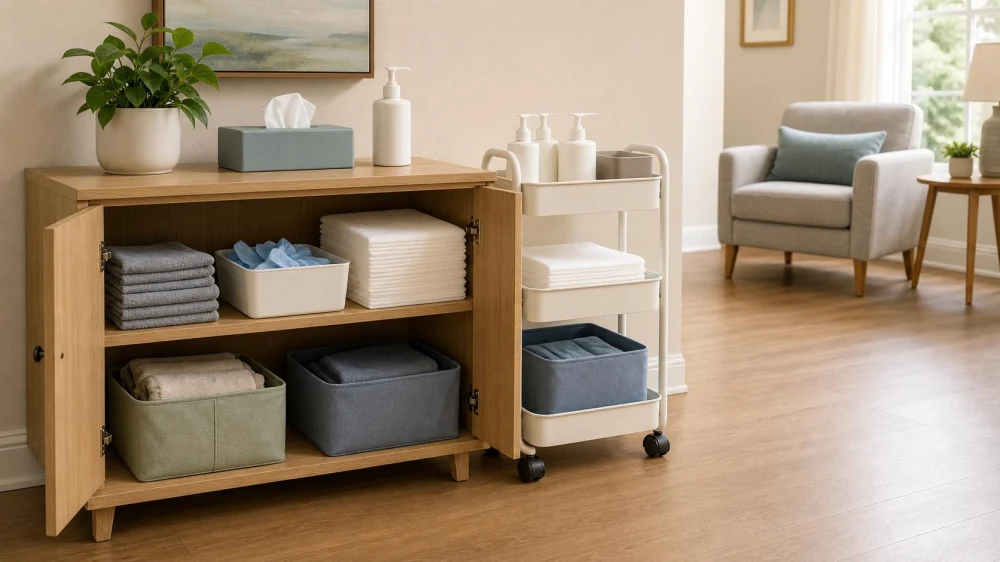
How to Organize Home Care Supplies Without Clutter
On this page
Quick answer
Organize home care supplies around the tasks people perform, not around where a package happens to fit. Keep a small daily-use zone within safe reach, store backup items separately, label containers clearly, and review quantities and dates on a regular schedule. Keep medications, chemicals, sharp items, and private records in their own controlled storage.
This guide is for family caregivers and shared-care households in the United States. It covers organization, not clinical decisions, medication changes, infection-control protocols, or storage instructions for a specific product.
All Care Home Health Provider
GlendaleLos Angeles CountyCalifornia
100 W Broadway #800, Glendale, CA 91210, USA
Start with the care routine
Before buying bins, list the recurring tasks in the home: personal care, dressing, meals, mobility support, laundry, cleaning, paperwork, and appointments. Note where each task happens and who performs it. Supplies used together should usually be easy to retrieve together.
Ask the person receiving care what they want visible, private, or within reach. A system that looks efficient to a caregiver may feel institutional or intrusive to the person who lives there. Preserve ordinary household spaces whenever possible.
Separate daily essentials from occasional items and unopened backups. Keeping every package in the active area makes it harder to see what is running low and can block counters, floors, and mobility routes.

ComForCare Home Care (Upland, CA)
UplandSan Bernardino CountyCalifornia
600 N Mountain Ave b200, Upland, CA 91786, USA
Create practical supply zones
Daily-use zone
Keep only the amount needed for a short, predictable period. Use a stable drawer, cabinet, or cart that does not narrow a walkway. Arrange supplies in the order they are normally used.
Backup inventory zone
Store unopened packages in a clean, dry location that meets the product label. Group like items and place older suitable stock in front so it is used first. Avoid attics, garages, or bathrooms when temperature or humidity could damage the contents.
Cleaning zone
Keep household chemicals separate from personal-care products, food, and medical supplies. Retain original labels and never transfer a chemical to a food or drink container.
Records zone
Store care plans, contact lists, receipts, and appointment notes in a location available to authorized caregivers but protected from casual visitors. Use a simple date and subject system so the latest information is easy to find.
Return and disposal zone
Use a clearly marked temporary container for items awaiting pharmacy return, approved sharps disposal, equipment pickup, or another proper disposal route. Keep it secure and do not let it become a permanent pile.
Label and track what you have
Use plain, large labels that describe the item and task. Color can support recognition, but do not rely on color alone because vision varies. Avoid abbreviations that a substitute caregiver might misunderstand.
A short inventory can record item name, usual quantity, reorder point, storage location, and relevant expiration date. Track only what is useful; a complicated spreadsheet that no one updates is less reliable than a one-page checklist on the inside of a cabinet.
Do not cover manufacturer labels, lot numbers, instructions, or expiration dates. If an item is removed from its package, make sure the new container is appropriate and the identity and instructions remain unambiguous.
Protect safety and privacy
- Keep floors, stairs, exits, transfer areas, and mobility-device routes clear.
- Anchor tall shelving and do not place heavy packages overhead.
- Store sharp objects, chemicals, batteries, and small choking hazards away from children, pets, and anyone who may use them unsafely.
- Keep medications in their labeled containers and follow the pharmacist's or product's storage instructions.
- Do not mix one person's supplies or records with another person's without clear separation.
- Protect names, diagnoses, insurance details, schedules, and access codes from unnecessary visibility.
- Keep sterile or clean items closed until needed and away from moisture, dirt, and opened chemicals.
Some supplies require refrigeration, temperature limits, light protection, or special handling. The package instructions and care team's directions take priority over a general organization system.
A step-by-step setup
- Choose one task area. Start with a single bathroom cabinet, bedside drawer, or meal-support area instead of emptying the whole home.
- Remove unrelated items. Return household objects to their normal locations and set aside products that belong to another task.
- Check labels and condition. Identify damaged, opened, expired, recalled, or unknown items. Follow the proper return or disposal route rather than guessing.
- Group by use. Put supplies for one routine together while preserving any required clean or secure separation.
- Set the daily quantity. Keep a manageable amount accessible and move unopened backup stock to its designated zone.
- Label the location. Use words that every regular and backup caregiver understands.
- Test the routine. Complete the normal task and note unnecessary reaching, searching, bending, or carrying.
- Adjust with consent. Ask the person receiving care whether the setup is comfortable, private, and easy to understand.
Keep the system working
Assign one person to review inventory while allowing every caregiver to report low stock or problems. Choose a review rhythm that matches how quickly supplies change. Fast-moving items may need frequent checks; occasional items need less attention.
Use a “one package opened at a time” rule when appropriate so duplicate packages do not become partially used. Record the open date only when the product instructions or care plan make it relevant.
Reassess after a hospital discharge, change in mobility, new equipment, caregiver change, or room move. The safest location for a supply can change when the care routine changes.
Home care storage checklist
- Daily items are near the task but do not block movement.
- Backup inventory is separate, clean, dry, and easy to count.
- Labels use clear words and readable print.
- Manufacturer labels and instructions remain visible.
- Medications, chemicals, sharps, and private records are secured appropriately.
- Heavy supplies are stored below shoulder height.
- Expiration dates and reorder points are reviewed.
- Authorized backup caregivers can find essentials.
- The person receiving care agrees with the setup.
Limitations and important notes
Organization cannot replace training on wound care, oxygen, feeding equipment, injections, infection control, lifting, or other skilled tasks. Ask the prescribing clinician, home health professional, pharmacist, or equipment supplier how to store and use specialized products.
Do not discard prescription medicine, controlled substances, needles, batteries, chemicals, or electronic medical equipment with ordinary trash unless local instructions explicitly allow it. US disposal options vary by community.
Frequently asked questions
Should all care supplies stay in one room?
Not necessarily. Store items near the tasks they support while maintaining safety, cleanliness, and access control. Keep a simple map if supplies are spread across the home.
Are clear bins always better?
They make inventory visible but may reduce privacy or create visual clutter. Opaque labeled containers may be better for personal items and records.
Can medications go into an organizer?
Ask the pharmacist or care team. Some medicines must remain in original packaging or have special storage needs, and an organizer does not prevent dosing errors by itself.
What should I do with expired supplies?
Follow the manufacturer, pharmacy, supplier, or local disposal program. Do not donate opened, damaged, expired, or recalled products.
How can multiple caregivers keep the system consistent?
Use shared labels, a short restocking rule, and one place to record issues. Explain changes during handoff instead of silently moving supplies.
Sources and evidence notes
The approach here reflects broad home-safety and caregiving practice: keep circulation routes clear, store hazards securely, preserve product labels, separate clean supplies from chemicals, and organize around repeatable tasks.
No clinical protocol, product storage temperature, disposal rule, or medication plan is assumed. Product instructions, the care plan, and local requirements control those details.
Next steps
Choose the care task that currently causes the most searching. Gather only the related supplies, remove expired or unknown items through the correct process, and build one labeled daily-use zone plus one backup zone. Test the setup with both the regular and backup caregiver, then ask the person receiving care what should be changed for comfort and privacy.






 Carnelian Villas Home Care - an ALW Provider4.0 (12 reviews)
 Hygieia Home Health and Hospice3.0 (2 reviews)
 Tri Care Home Health Services Inc5.0 (2 reviews)
 Comfort Caregiving5.0 (2 reviews)
 Senior Oasis5.0 (16 reviews)
 24 Hour Caregivers - Orange County Home Care Services5.0 (14 reviews)
 Tips for Using Technology to Support Mental and Social Engagement
 How Robotics is Shaping the Future of Home Care
 How to Make Home Care Activities Engaging and Rewarding
 Tips for Encouraging Older Adults to Try New Hobbies and Skills
 How to Create a Yearly Wellness Plan for Your Pet
 Tips for Maintaining Cognitive Health Through Daily Mental Challenges