After an Older Adult Falls: A Caregiver Action Guide
On this page
Quick answer
After an older adult falls, keep them still briefly, check responsiveness, breathing, pain, bleeding, head impact, and visible deformity, and do not rush them upright. Call 911 for unconsciousness, breathing trouble, severe bleeding, new confusion or neurologic symptoms, suspected head, neck, back, or hip injury, or inability to get up safely. Even without obvious injury, report the fall to the person's healthcare professional.
A fall is an unexpected event in which a person comes to rest on the ground, floor, or a lower level. It may reveal an injury or an underlying issue involving illness, medicine, blood pressure, vision, balance, strength, footwear, or the home environment.
What to do in the first minutes
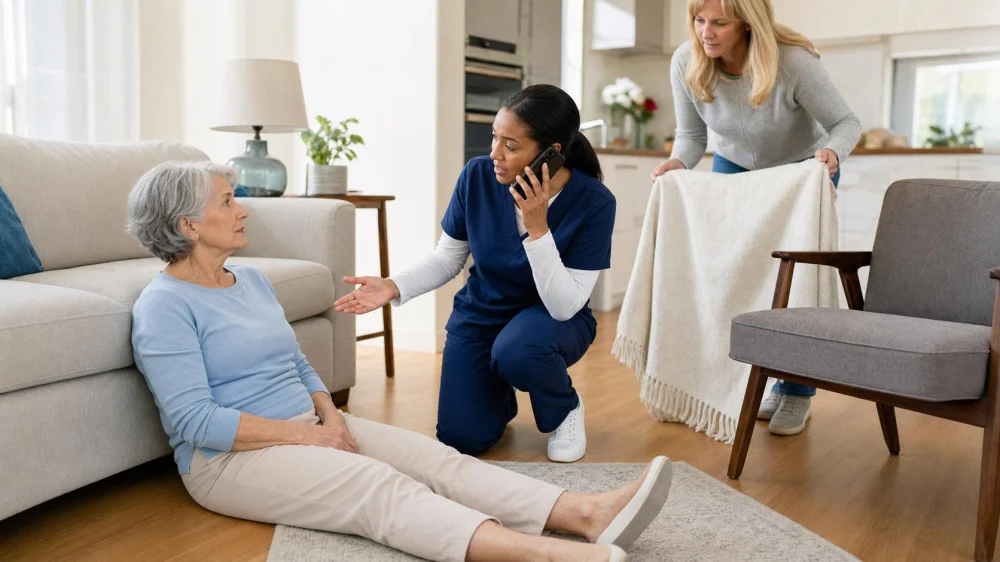
- Stay calm and make the area safe. Stop traffic, move hazards only if that does not require moving the person, and keep pets away.
- Check responsiveness and breathing. If the person is unresponsive or not breathing normally, call 911 and follow dispatcher instructions.
- Ask what hurts and what happened. Check for head impact, dizziness, chest symptoms, weakness, severe pain, bleeding, and a shortened or oddly positioned limb.
- Do not lift automatically. Moving someone with a possible fracture or head, neck, or back injury can worsen harm.
- Keep them comfortable. If no immediate hazard exists, let them remain in place while help is arranged. Keep them warm without giving food, drink, or medicine if emergency evaluation may be needed.
If the person appears uninjured and says they can rise, the National Institute on Aging advises moving slowly, resting between position changes, and using a sturdy chair. A caregiver should not attempt a manual lift beyond their training or physical ability. Use the person's established care plan or lifting equipment when applicable.

Casa Blanca Senior Care
BellflowerLos Angeles CountyCalifornia
13833 Birkhall Ave, Bellflower, CA 90706, USA
Call 911 for emergency warning signs
- loss of consciousness, seizure, or abnormal breathing;
- new confusion, slurred speech, facial droop, one-sided weakness, or severe sudden headache;
- severe or uncontrolled bleeding;
- suspected head, neck, spine, hip, or major bone injury;
- chest pain, severe shortness of breath, or fainting;
- repeated vomiting, worsening drowsiness, or rapidly worsening symptoms;
- inability to get up safely or no safe person/equipment available to assist.
Use a lower threshold for urgent help after head impact when the person takes an anticoagulant or antiplatelet medicine, has a bleeding disorder, has osteoporosis, or cannot reliably describe symptoms. Follow the prescribing clinician's or care plan's instructions.
Why follow-up matters even after a minor fall
The National Institute on Aging recommends telling a doctor about every fall, even without pain. A clinician may evaluate injury and look for modifiable causes such as a new infection, dehydration, low blood pressure on standing, vision or foot problems, medication effects, weakness, balance changes, or an unsafe mobility aid.
Do not stop, skip, or reduce prescription medicines on your own. Ask the prescriber or pharmacist for a medication review, especially after a new medicine, dose change, dizziness, sleepiness, or low blood pressure.
Create a useful fall record
- date, time, exact location, and who witnessed it;
- activity immediately before the fall and whether the person felt dizzy or faint;
- footwear, walking aid, lighting, floor condition, and obstacles;
- suspected head impact and where the body landed;
- pain, skin injury, swelling, mental status, and ability to bear weight;
- actions taken, people notified, and changes observed afterward.
Follow agency policy and privacy rules. Documentation supports care; it should not assign blame or substitute for clinical assessment.
Use the event to prevent another fall
After urgent needs are addressed, review the circumstances with the person and care team. CDC's STEADI framework considers medication, gait and balance, feet and footwear, vision, blood pressure, health conditions, and home hazards. An occupational therapist can assess the home, while a physical therapist can evaluate strength, mobility, and assistive-device use.
Do not respond by restricting all activity without clinical advice. Fear and deconditioning can reduce independence and may increase future risk. Use a personalized plan that supports safe movement.
Evidence note: This guide draws on the NIH National Institute on Aging's fall response and prevention guidance and the CDC's STEADI resources. It is general information, not diagnosis or individualized emergency instructions.
Frequently asked questions
Should I help the person up right away?
No. First assess for injury and emergency signs. If help is needed or injury is possible, call emergency services rather than attempting an unsafe lift.
What if the person says they feel fine?
Continue observing and report the fall to their healthcare professional. Some injuries or head-injury symptoms may not be obvious immediately.
Should a caregiver use a gait belt after a fall?
Only if trained, the person's plan permits it, and injury has been ruled out. A gait belt is not an emergency lifting device.
Does one fall mean home care is no longer safe?
Not necessarily. It signals a need for assessment. The response may involve medical treatment, therapy, equipment, home changes, supervision, or a different care setting depending on findings.
Next steps
Post emergency numbers and the care plan where caregivers can find them, keep a charged phone or alert device within reach, and agree on who must be notified after any fall. Review the incident with the healthcare team and turn its specific circumstances into a prevention plan.


 Nextdoor Homecare5.0 (6 reviews)
 All You Need HHC5.0 (4 reviews)
 Keen Home Care & Homes3.0 (17 reviews)
 Bella Terra Hospice4.0 (45 reviews)
 Visiting Angels Senior Home Care Orange4.0 (12 reviews)
 Home Instead, Home Care Services of San Gabriel4.0 (13 reviews)
 Tips for Helping Seniors Stay Connected Through Technology
 How to Encourage Seniors to Maintain Social Connections Virtually
 Strategies for Promoting Sleep Hygiene and Better Rest in Older Adults
 The Benefits of Volunteering for Seniors: Purpose, Health, and Connection
 How Home Care Helped a Senior Recover After Surgery
 Strategies for Incorporating Mindfulness and Relaxation Into Daily Routines