
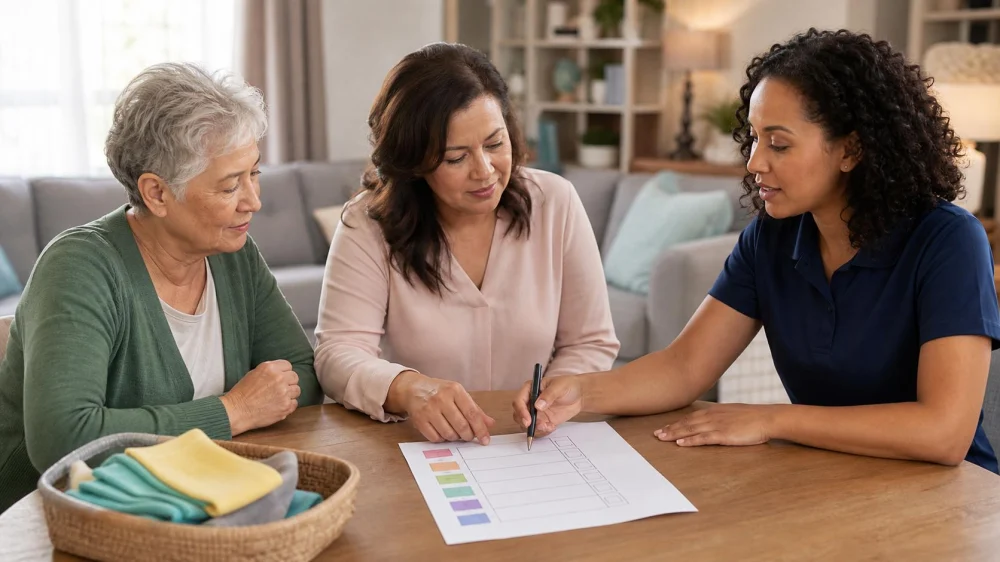
Home Care Household Tasks: Agree on Scope Before Visits
On this page
Quick answer
Before home care begins, list the household tasks that directly support the person receiving care, then confirm them against the service agreement, caregiver training, agency policy, available visit time, and household safety. Define frequency, supplies, preferred method, and completion standard. Create a clear “stop and call” path for spills, pests, broken equipment, unsafe lifting, hazardous chemicals, or requests outside the authorized scope.
This guide supports administrative planning for U.S. home care. Contracts, worker classification, agency rules, payer coverage, state requirements, clinical plans, and household conditions differ. The current authorized service plan controls.
Visiting Angels
CerritosLos Angeles CountyCalifornia
18000 Studebaker Rd Suite 700, Cerritos, CA 90703, USA
What task scope means
Household task scope defines which non-clinical chores a caregiver may perform, for whom, under what conditions, and within what visit time. Clear scope protects the person’s priorities and prevents a routine visit from becoming an improvised cleaning, repair, moving, or property-management service.
“Light housekeeping” is not self-explanatory. One plan may include wiping the person’s meal area and changing bed linens; another may exclude bathrooms, pet care, family laundry, ladders, outdoor work, or chemical cleaning.
Connect each task to the care recipient’s daily support. If a request mainly serves the whole household or requires a specialized trade, ask the agency or coordinator before assigning it.

TheKey - Formerly 123 Home Care
Santa MonicaLos Angeles CountyCalifornia
2500 Broadway building f suite 125, Santa Monica, CA 90404, USA
Build the household task list
Walk through the home with the person receiving care and an authorized representative when appropriate. For each room, identify the few tasks that support safety, comfort, nutrition, hygiene, access, or participation.
- Kitchen: agreed meal cleanup, wiping the used preparation area, dishes from the visit, and safe food storage tasks.
- Bedroom: making the bed, changing approved linens, keeping the immediate route clear, and placing frequently used items within reach.
- Bathroom: only the routine surfaces and supplies defined by the plan, with privacy and infection-control instructions.
- Laundry: whose clothing or linens, which cycles, where items are stored, and what must be handled separately.
- Living areas: agreed light tidying, removal of trip hazards that can be handled safely, and placement of personal items according to preference.
Do not assume “clean” means the same thing to everyone. Write an observable endpoint such as “used dishes washed and returned” rather than a broad demand to “clean the kitchen.”
Set clear boundaries
Mark tasks that are excluded or require separate authorization: climbing ladders, moving heavy furniture, lifting the person without approved methods, handling sharps or bodily fluids outside training, pest or mold remediation, deep cleaning, snow removal, yard work, repairs, driving, pet handling, or work for other household members.
Separate household chores from personal care and clinical tasks. Medication, mobility, transfers, wound care, diets, exercises, and medical equipment must follow the current care plan, training, and authorization.
Discuss time tradeoffs. If the visit includes meals, personal support, and an appointment, some household tasks may need to move. Identify which priorities cannot be skipped and who approves schedule changes.
Match supplies and instructions
List who provides gloves, cloths, detergent, trash bags, and approved cleaning products. Keep products in original labeled containers and follow their directions. Never mix cleaning chemicals or transfer them into drink containers.
Record allergies, sensitivities, surface restrictions, ventilation needs, pet controls, and where supplies are stored. Replace damaged tools and do not use an unstable stool, broken vacuum, frayed cord, unguarded blade, or unknown chemical.
When infection-control or hazardous-material precautions are required, use current agency and public-health instructions rather than a generic household checklist.
Handle changes during a visit
- Pause the request. Do not begin unfamiliar or unsafe work.
- Clarify the goal. Ask what outcome the person needs, not only which chore was requested.
- Check authorization. Review the service plan or contact the supervisor through the approved channel.
- Offer an in-scope alternative. For example, clear a small safe route instead of moving heavy furniture.
- Document facts. Record the request, condition observed, response, and person contacted without blame.
- Arrange the right service. A cleaner, plumber, electrician, pest professional, waste service, or emergency responder may be more appropriate.
Do not punish or shame the person for a request. A scope gap may mean the care plan needs review, not that the underlying need is unimportant.
Pre-visit checklist
- Person’s household priorities recorded
- Included tasks tied to the authorized service plan
- Frequency and observable completion standard defined
- Tasks for other household members addressed separately
- Excluded, trained-only, and trade-specific work listed
- Visit-time priorities and tradeoffs agreed
- Supplies, labels, storage, and safety instructions checked
- Stop-and-call contact pathway visible to staff
- Change documentation method confirmed
Limitations and safety notes
- Do not mix chemicals, use unlabeled products, or clean an unknown hazardous substance.
- Do not climb, lift, repair, drive, or use powered equipment outside training and authorization.
- Do not move medications, documents, valuables, access devices, or personal items without consent and approved handling.
- Fire, gas odor, electrical hazard, sewage, structural danger, violence, or medical emergency requires the established emergency pathway.
- Recurring unmet household needs should trigger service-plan review rather than repeated informal exceptions.
Frequently asked questions
What does light housekeeping include?
There is no universal definition. Use the written service agreement and list exact tasks, rooms, frequency, and exclusions.
Can a caregiver clean for the whole family?
Only if that work is explicitly included and authorized. Many home care plans limit tasks to the person receiving care and their immediate environment.
What if a task takes longer than the visit?
Use the agreed priority order, tell the person what can be completed, and contact the coordinator when the schedule or service level needs review.
Can the caregiver use household cleaning products?
Only products and methods allowed by the plan, label, training, and household safety instructions. Unknown or damaged products should not be used.
How should an unsafe condition be reported?
Describe the location, what was observed, immediate action, and who was contacted through the approved documentation and escalation system.
Sources and evidence notes
This article follows general person-centered service and workplace-safety principles: define duties, connect tasks to the care recipient, respect consent and property, use labeled products, avoid untrained hazards, document changes factually, and route specialized work to qualified services. Exact scope depends on the care arrangement.
Next steps
Choose the five household tasks that most support the person’s day. Write the room, frequency, method, supplies, completion point, and any stop condition for each. Compare the list with the service agreement and agency policy, remove ambiguous phrases, and confirm who must approve future changes.






 Cristina’s Private Caregiver5.0 (1 reviews)
 Splendoor In Home Care LLC0.0 (0 reviews)
 Loyal Care At Home, Inc5.0 (3 reviews)
 Vantage Home Health Care Services5.0 (1 reviews)
 SG Homecare, Inc.1.0 (191 reviews)
 Comfort Keepers of Long Beach, CA5.0 (1 reviews)
 How to Help Seniors Stay Mentally Stimulated with Puzzles and Games
 How to Use Arts, Crafts, and Music to Enhance Daily Life for Seniors
 How to Use Gardening for Physical and Mental Wellness in Older Adults
 How to Organize Home Care Supplies Without Clutter
 Techniques for Encouraging Seniors to Stay Socially Connected in Small Communities
 Strategies for Encouraging Seniors to Stay Independent in Daily Tasks